What Continuous Monitoring Means
Connecting to LMS... Progress: in progress
Narration
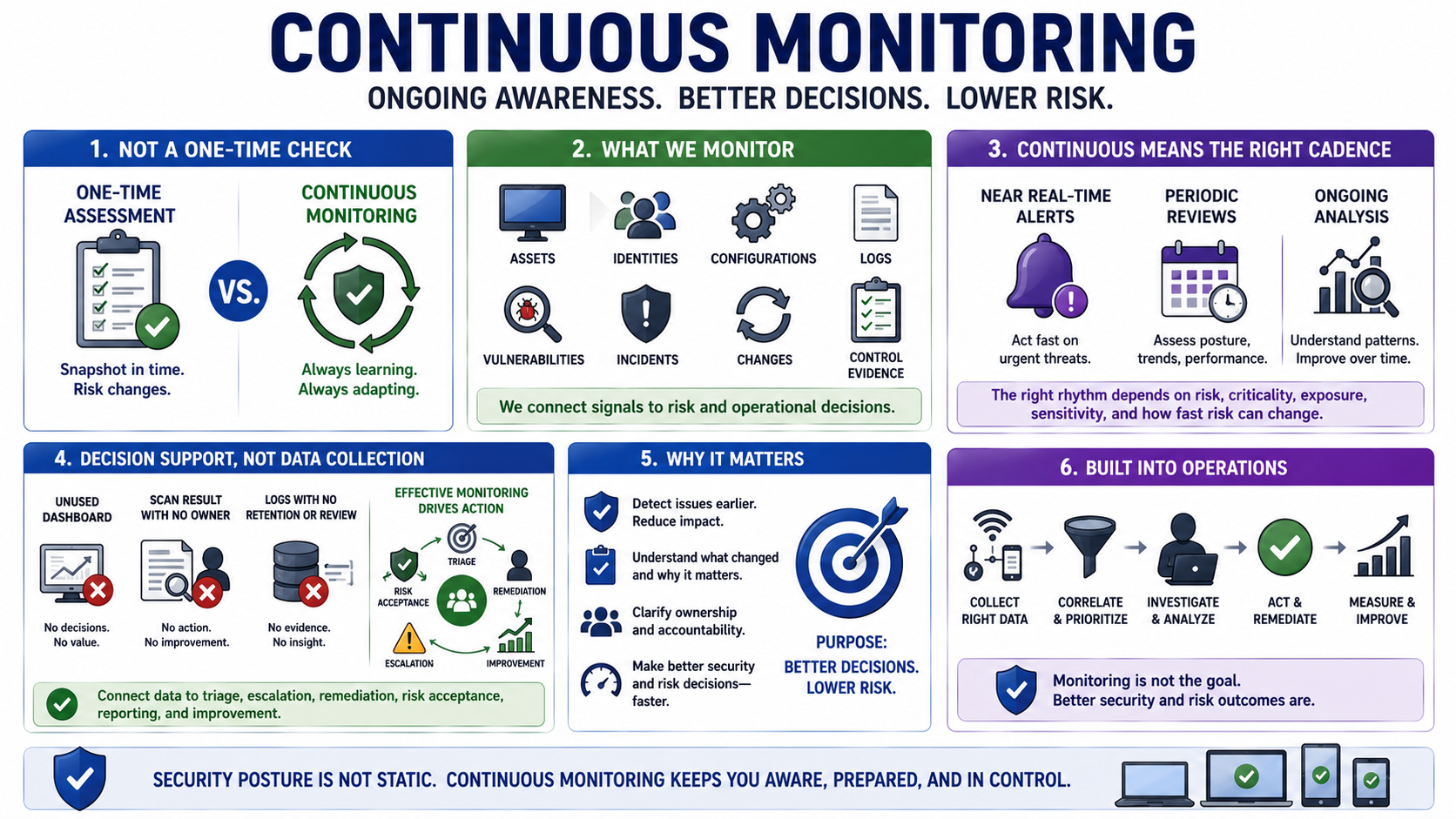
Continuous monitoring is the ongoing process of maintaining awareness of security posture, control effectiveness, system changes, vulnerabilities, threats, and risk. It is not the same as running one assessment before launch and then assuming the system remains safe. Modern systems change constantly. Assets appear, identities are added, configurations drift, vulnerabilities are disclosed, incidents occur, and business use evolves. Monitoring exists because security posture is not static.
A useful continuous monitoring program watches the parts of the environment that influence risk: assets, identities, configurations, logs, vulnerabilities, incidents, changes, and control evidence. It connects technical signals to operational and risk decisions. That means monitoring should not stop at displaying dashboards. It should help people understand what changed, why it matters, who owns it, and what action should happen next.
The word continuous does not mean every signal is reviewed every second by a person. It means monitoring is built into normal operations and repeated at a cadence that fits the risk. Some signals may need near-real-time alerting. Others may support periodic review, trend analysis, or audit readiness. The right rhythm depends on criticality, exposure, sensitivity, regulatory context, and how quickly risk can change.
Continuous monitoring is decision support. A dashboard that no one uses is not a program. A scan result with no owner is not remediation. A log stream with no retention or review plan is not evidence. Effective monitoring connects data to triage, escalation, remediation, risk acceptance, reporting, and improvement. The purpose is not to collect the most data; it is to make better security and risk decisions faster and more consistently.