Course Summary and Key Takeaways
Connecting to LMS... Progress: in progress
Narration
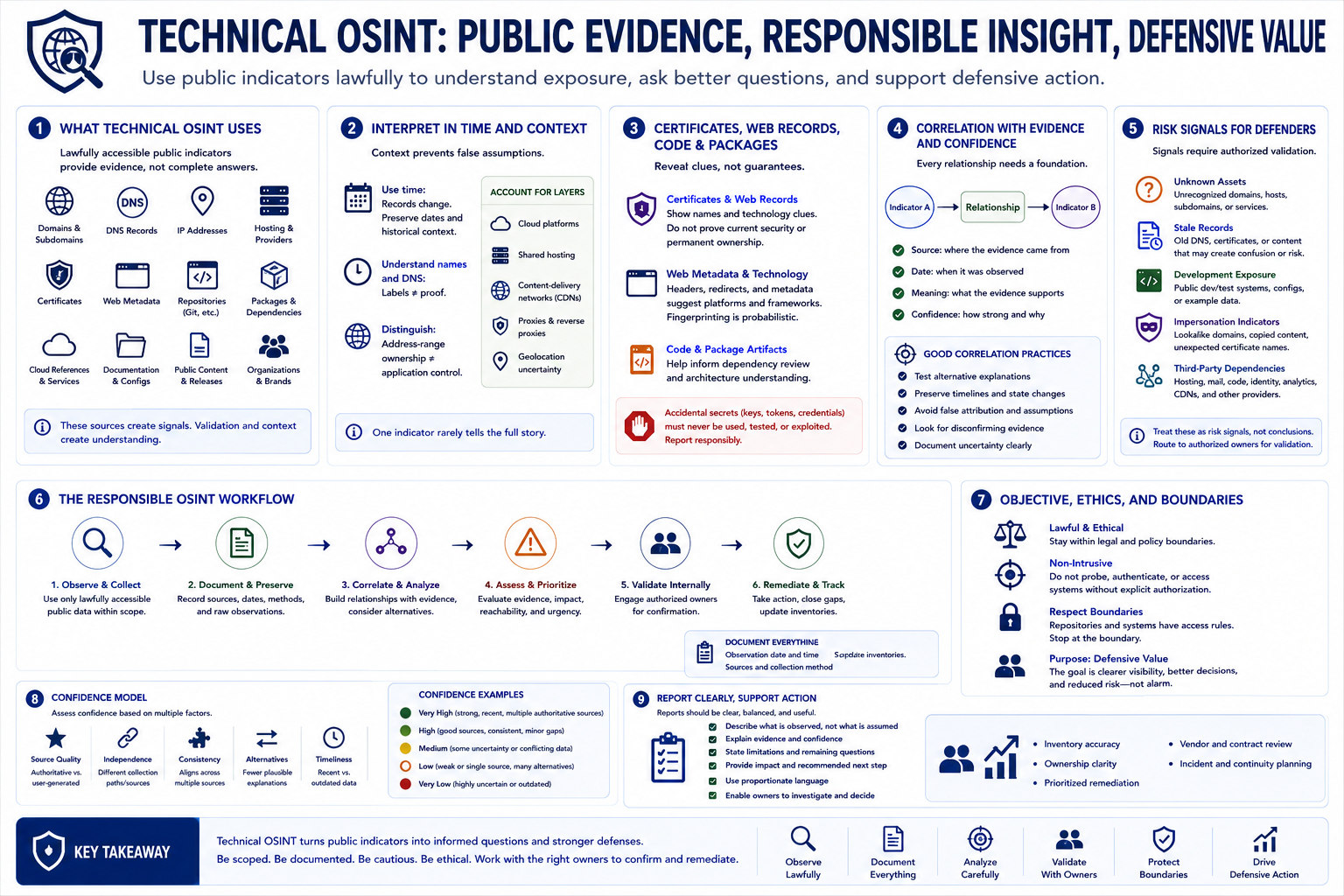
Technical OSINT uses lawfully accessible public indicators to help defenders understand internet-facing exposure. Domains, DNS, addresses, hosting, certificates, web metadata, repositories, packages, and cloud references provide evidence, but rarely provide complete answers alone.
Interpret naming and DNS in time and context. Distinguish address-range ownership from application control, and account for cloud platforms, shared hosts, content-delivery networks, proxies, and geolocation uncertainty.
Certificate and web records can reveal names and technology clues without proving current security or permanent ownership. Public code and package artifacts can inform dependency review, but accidental secrets must never be used.
Correlation works when every relationship has a source, date, meaning, and confidence. Test alternatives, preserve timelines, and avoid false attribution. Report unknown assets, stale records, development exposure, impersonation indicators, and third-party dependencies as risk signals requiring authorized validation.
The objective is responsible visibility and decision support, not intrusive testing. Strong technical OSINT is scoped, documented, cautious, ethical, and connected to internal owners who can confirm and remediate findings.